
The Real Cost of the Cheapest Box: Why Packaging Price Isn’t the Same as Total Delivered Cost
A lower unit price on a thermal shipper can produce a higher total cost...
read Details
Thermal packaging is often treated as a single decision made once, at the start of a program, and revisited only when something goes wrong. In practice, it is a discipline that runs the length of a product’s lifecycle.
A package that passes qualification testing can still encounter conditions in transit the test never anticipated. A lower unit price can produce a higher total cost of delivery once freight, handling, and risk are accounted for. A packaging change made after a filing is submitted or approved is a regulatory event, not a vendor swap. A reusable system that looks fine after prior use can perform differently on its next shipment unless that performance is proven, not assumed. And packaging that made sense during clinical trials is not automatically the right fit once a program reaches commercial scale.
These are not isolated problems. They are connected points in the same discipline: using tested, documented, and defensible engineering judgment to protect a product through every stage of distribution.
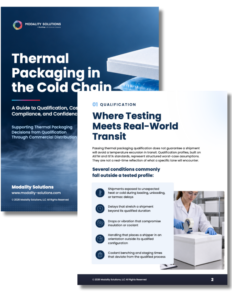
This guide walks through each of these realities in turn, covering qualification, total delivered cost, regulatory compliance, reuse validation, and the clinical-to-commercial transition, with the engineering perspective needed to make each decision defensible.
A lower unit price on a thermal shipper can produce a higher total cost...
read Details
Passing thermal packaging qualification testing does not guarantee a shipment will avoid temperature excursions...
read Details
Cost conversations in biopharma cold chain often start in the wrong place. Teams focus...
read Details