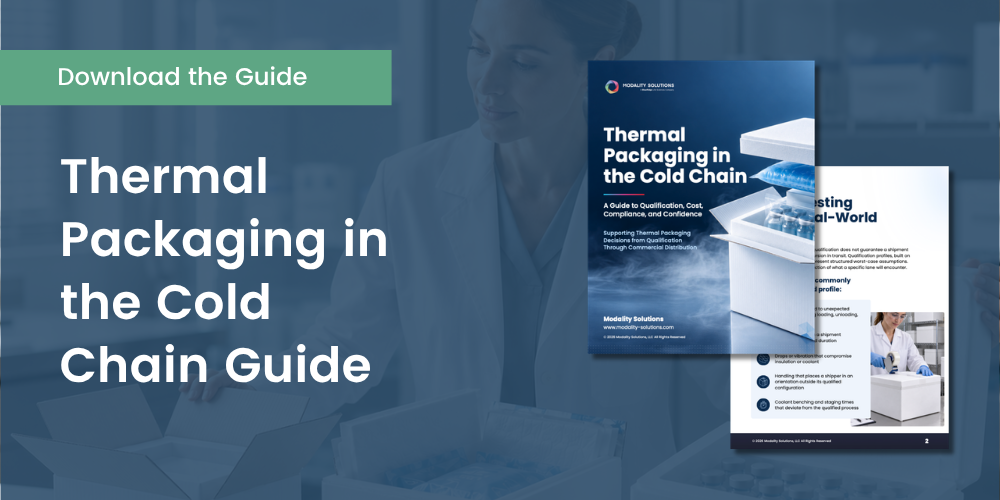
Switching Thermal Packaging Mid-Approval: What FDA Regulations Actually Require
A thermal packaging change during an approved or submitted commercialization state is a regulatory...
read Details
A lower unit price on a thermal shipper can produce a higher total cost of delivery. Qualified duration determines which transportation service levels are available, and a package that cannot hold temperature long enough often forces a faster, more expensive shipping method to stay safe. Comparing packaging on price alone, without accounting for the shipping decision it forces, produces a total cost picture that looks nothing like what procurement approved.
When companies evaluate thermal packaging, unit price is an obvious place to start. But the least expensive shipper is not necessarily the least expensive way to deliver a temperature-sensitive product. This is one of the most common blind spots we see in cold chain programs at Modality Solutions.
Packaging performance influences freight options, handling requirements, operational labor, and product risk. A lower-cost thermal shipper that offers a shorter qualified duration (the length of time a thermal shipper is proven, through lab testing, to maintain required product temperature). may leave little margin for delays or require a faster transportation service to compensate. On the other side, a higher-performing package may cost more upfront but create the flexibility to use a slower, less expensive service.
Evaluating packaging without the freight decision it forces misses the actual cost of getting a product where it needs to go. The two are parts of the same economic decision, not separate line items on a budget, and it’s a distinction we help clients work through as part of cold chain engineering.
For biopharmaceutical companies, the question worth asking isn’t “How much does this box cost?” It’s “What does it cost to safely deliver this product?”
Consider two passive thermal packaging systems. One provides approximately 48 hours of qualified thermal protection. Another provides 72 hours.
There is no universal rule that a 72-hour shipper automatically makes three-day transportation possible. Carrier service, shipping lane, existing contracts, cutoff times, and required delivery dates all affect that decision. But additional qualified duration can provide something valuable: transportation margin and flexibility.
A 48-hour shipper used with two-day service may leave limited tolerance for handling or transit delays. A 72-hour system may provide an additional day of thermal protection and, for the right lane, make a slower transportation option feasible. That freight difference can outweigh the packaging price difference.
That freight difference can outweigh the packaging price difference, as the example above shows. The reverse is also true. Selecting expensive, over-engineered packaging for a predictable, low-risk lane can add material, storage, and freight costs without producing a meaningful reduction in supply chain risk.
The objective is to identify the lowest-cost qualified configuration that provides the thermal and mechanical performance, transportation margin, and operational flexibility the distribution network actually requires, not simply to buy the cheapest or the most robust packaging available. Anything beyond that is paying for performance the lane doesn’t need, and anything short of it is transferring risk onto the shipment. Determining where that line sits for a specific product and lane is engineering work, not a spec sheet lookup.
It’s worth noting that cheaper packaging isn’t automatically the wrong call. For products without strict temperature requirements, typically small molecules with wider stability margins, a lower-cost shipper can be the right economic and operational choice. The distinction that matters isn’t price; it’s whether the packaging is qualified for what the product and lane require.
In practice, thermal packaging decisions usually do start in the right place. Shipper capacity and qualified duration tend to be considered first, with packaging cost and freight cost for the shipping lane following as natural next questions. That sequence is sound.
Where the total cost picture can still get missed is in how completely that second step gets modeled. Packaging cost and freight cost are often evaluated as their own line items rather than combined into a single total-delivered-cost view, particularly when qualification happens early in a program, and the shipping lane or service level isn’t finalized until later. By the time a team is confirming whether overnight or two-day service is appropriate for a given shipment, the packaging’s qualified duration has already narrowed which service levels are realistic.
This isn’t a visibility gap so much as a modeling gap. The right inputs are usually being asked about. The question is whether they’re being combined into one comparison before the packaging decision is finalized, or evaluated separately in a way that leaves the true cost impact to show up later, in freight invoices or service level constraints, after the packaging is already qualified and difficult to revisit without triggering additional testing and regulatory review.
A meaningful comparison goes well beyond the purchase price of the thermal shipper. A real total-delivered-cost analysis should account for:
Product quality belongs in the equation as well. An underperforming solution can create costs that dwarf relatively small packaging savings if a temperature excursion results in an investigation, product replacement, or loss of high-value product. Cheaper packaging does not equal cheaper shipping. A cheaper shipper can increase total landed cost if it has a shorter qualified duration, larger external dimensions, lower payload efficiency, or requires a more expensive transportation service to stay safe.
Human factors matter too. Even the highest-performing thermal shipper can underperform if it is packed incorrectly. Packaging selection should account for the operating environment and be supported by appropriate standard operating procedures, packout instructions, and training.
The formula procurement is rarely shown before a packaging decision is made looks less like cost per shipper multiplied by shipment volume, and more like this: Total delivered cost = packaging + freight + handling + labor + conditioning + storage + expected cost of failures.
Any cost comparison based on thermal duration is only as reliable as the performance data behind it.
ISTA 7E provides a particularly useful framework for evaluating thermal transport packaging under challenging temperature conditions, and it’s best used as a worst-case profile for qualifying duration. At Modality Solutions, engineers load a shipper with a worst-case payload configuration, maximum thermal mass for dry ice passive shippers, minimum thermal mass for PCM panel or brick-based shippers, and expose it in a thermal chamber to ISTA 7E summer and winter profiles, rather than relying on a supplier specification sheet.
Modality Solutions’ involvement with ISTA 7E runs deep. Our founders helped develop the standard using hundreds of thousands of cold chain data points to build a statistically sound representation of the thermal challenges products truly encounter during transportation.
That expertise matters because a technically qualified package is only part of the decision. Engineers have to interpret test results against the product, the expected lane duration, operating requirements, and potential transportation hazards to determine whether a packaging or service level change actually makes sense for that specific shipment, not just in general.
Transport simulation plays a different but related role. Our Advantage Transport Simulation Laboratory™ doesn’t qualify a thermal packaging solution or its duration. Instead, it demonstrates that a product loaded into a worst-case shipper and exposed to worst-case thermal, vibration, shock, pressure, and humidity conditions can still maintain its integrity. That result sets a baseline: any properly qualified shipper a client selects afterward provides additional thermal assurance beyond what was demonstrated in that worst-case test. It’s a way of proving the floor, not the ceiling, and it’s part of what makes a duration claim defensible rather than assumed.
Thermal packaging procurement should not be an exercise in minimizing a single line item. A less expensive shipper can increase total delivered cost if it reduces transportation flexibility, requires additional operational effort, or increases product risk. Paying for performance a supply chain does not need can waste money just as easily.
A full total-delivered-cost comparison does not eliminate every variable. Freight rates change, lane conditions shift, and carrier performance is not entirely predictable even with a well-qualified package. Without client-specific data, no comparison can state that a shipper qualified for a given duration will automatically unlock a specific cheaper service level. The lane, carrier, contract terms, cutoff times, and required delivery date determine that, not shipper duration alone. What the comparison provides is a defensible basis for the decision, built on tested performance data rather than assumption, so that when conditions do change, the packaging choice was made with the actual tradeoff in view.
Modality Solutions helps biopharmaceutical companies evaluate packaging within the context of the entire cold chain, including packaging selection and qualification, logistics network design, transport risk, and opportunities to reduce shipping and packaging costs while maintaining product protection. The goal is not the cheapest box. It is the most technically and economically appropriate system for getting a valuable product safely where it needs to go.
If you are evaluating thermal packaging, freight costs, or opportunities to optimize an existing commercial cold chain, our cold chain engineering team can help you look beyond unit price to understand the true cost and risk of your distribution strategy. Schedule a consultation to get started.
Q. Does a longer qualified duration automatically mean a company can use cheaper shipping?
A. No. Qualified duration is only one factor. The lane, carrier, contract terms, cutoff times, and required delivery date also determine which transportation services are actually feasible.
Q. What qualified durations commonly affect transportation planning?
A. There is no defined threshold, but 48 and 72 hours are common practical breakpoints. A 48-hour shipper typically supports two-day service, while a 72-hour shipper can often support three-day service and reduce or eliminate the need for expedited transport.
Q. What should be included in a total-delivered-cost analysis?
A. At minimum, teams should consider qualified duration relative to expected transit time, active versus passive packaging requirements, shipper cost, freight cost, handling, labor, conditioning, storage, shipment volume, and the expected cost of failures.
Q. Can the cheapest thermal packaging ever be the right choice?
A. Yes. Products without strict temperature requirements, typically small molecules, can often use lower-cost packaging without added risk. The right question isn’t price; it’s whether the packaging is qualified for what the product and lane require.
Q. Does a shorter qualified duration always mean higher shipping costs?
A. Not necessarily, but it often does once the shipment exceeds the shipper’s qualified window. If the qualified duration is shorter than the actual transit time, the shipment typically requires expedited freight, overnight or priority air, to avoid a temperature excursion. In a representative case, a lower-cost shipper might save around $2,000 in base freight charges, but the expedited shipping premium required to compensate for its shorter duration often exceeds that savings. A higher-qualified shipper can travel at standard shipping speeds, avoiding the need for expedited transport in the first place.
Q. What’s the difference between packaging qualification and transport simulation testing?
A. Packaging qualification, typically performed against ISTA 7E summer and winter profiles, establishes a shipper’s qualified duration, how long it can maintain required product temperature under worst-case conditions. Transport simulation testing serves a different purpose. It doesn’t qualify a shipper or its duration. Instead, it demonstrates that a product loaded into a worst-case shipper and exposed to worst-case thermal, vibration, shock, pressure, and humidity conditions can still maintain its integrity. That result establishes a baseline: any properly qualified shipper selected afterward provides additional thermal assurance beyond what was demonstrated in that worst-case test.
Q. How does Modality Solutions help companies evaluate thermal packaging costs?
A. We combine thermal packaging selection and qualification, ASTM and ISTA testing, transport simulation, and cold chain engineering expertise to evaluate packaging within the context of the product and supply chain, rather than treating the shipper as an isolated procurement decision.
A thermal packaging change during an approved or submitted commercialization state is a regulatory...
read Details
Passing thermal packaging qualification testing does not guarantee a shipment will avoid temperature excursions...
read Details
Thermal packaging is often treated as a single decision made once, at the start...
read Details